
Builder-grade kitchens have a flatness to them. Nothing is wrong, exactly. The cabinets close properly. The appliances function as intended. However, the room gives the impression of having been assembled from prefabricated parts. Like something from a catalog. Every house on the block probably has the same one. The gap between that and a kitchen that actually feels custom? To be truthful, it’s not as broad as most assume.
Forget the Full Gut Job
There’s an assumption that getting a custom look means ripping everything out. New plumbing, new layout, walls coming down, months of living without a functioning kitchen. Projects like that blow past budgets fast and test every relationship in the household.
Read More: The Easiest Way to Make a Kitchen Look Custom Built
But that is not where the custom feel actually comes from. Spend an afternoon walking through open houses in a nicer neighborhood and really pay attention. The thing that separates those kitchens from average ones usually isn’t the cabinet brand. It’s the surfaces. How the counter meets the wall. How edges are finished. Whether the stone flows across the space or gets chopped up by bad seams and mismatched tones. Surfaces run the show. Everything else plays backup.
The Single Change That Punches Hardest
For the same expense, changing kitchen countertops has a greater impact on a room’s personality than most other improvements. The right slab causes cabinets, walls, and flooring to interact in a way they hadn’t previously. Things start to look intentional. Bedrock Quartz gets involved early in the templating process and works around each kitchen’s specific dimensions. This includes awkward corners, uneven walls and weird island angles, so the finished counter reads like it was built into the room from day one rather than trimmed to fit after the fact.
That difference is visible. A counter that wraps a tricky corner with no compromise looks like money. Looks like somebody planned it. Even when the cabinets underneath haven’t changed since the house was built.
Let the Material Do the Work
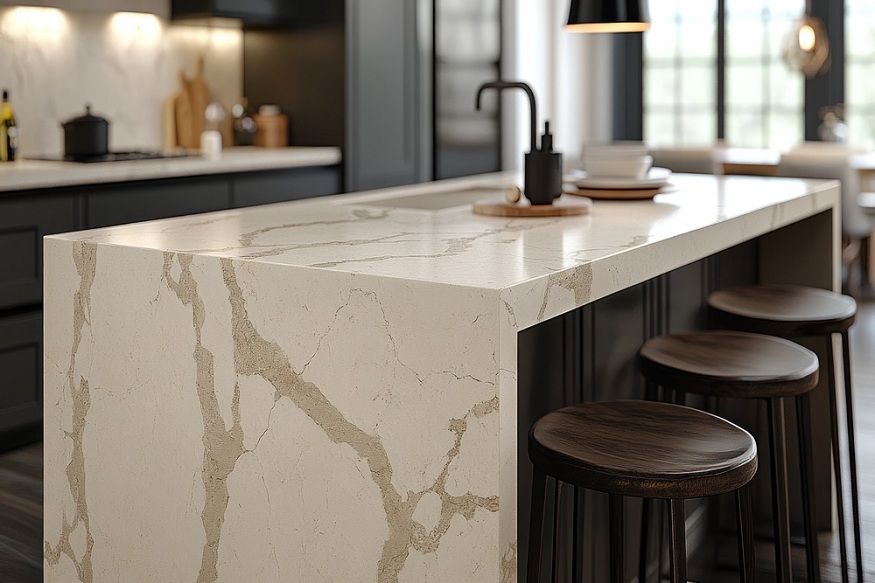
Laminate counters disappear into a room. That is the entire issue. They don’t give the eye anywhere to land. Put in stone with some movement like veining, mineral flecks, a finish with actual texture, and suddenly there’s an anchor. The room organizes itself around that surface. Dark cabinets paired with lighter stone offer a designed, rather than random, contrast. Using white cabinets paired with a striking veined slab can give a kitchen a much more luxurious appearance.
Even changing the edge profile adds a surprising amount of visual weight. Squared-off edges feel modern. Beveled or ogee edges lean traditional. Nobody notices edge profiles consciously, but everyone registers the difference.
Cheap Tricks That Don’t Look Cheap
Running the counter material up the wall behind the stove or sink is one of those moves that immediately elevates a kitchen. It creates a continuous line that looks architectural. And it takes zero structural changes to pull off. Undermount sinks paired with a clean stone edge is another one. The counter flows right to the basin without a lip interrupting it. Tiny detail. The entire setup seems more sophisticated than it should be.
Read More: The Easiest Way to Make a Kitchen Look Custom Built
Conclusion
The bones are usually fine. Layout works. Cabinets function. What’s lacking is a surface to unify the room and add a sense of weight. Focus on that one crucial element: the correct stone, expertly crafted and fitted seamlessly, and the rest of the space will fall into place. People walk in and the kitchen just feels finished. Put together. Like somebody sat down and thought it through, which at that point, somebody actually did.